Celebrity autographs · Editorial field guide
An Autographed 8×10 Photo: The Evidence to Request Before Buying
Affiliate disclosure: Some marketplace links earn a commission if you buy. Listings are seller descriptions—not independent authentication or proof of value.
Quick answer. An 8×10 signed photograph raises two different authenticity issues: when the photograph was printed and whether the ink was hand-applied. The practical goal here is photo print era, ink, inscriptions and documented source, while keeping uncertain details visibly uncertain.
This guide is for someone handling signed object and signature evidence—whether deciding what to buy, documenting a family find, or preparing a defensible sale description. The key is to investigate the exact example rather than relying on a broad category name.
What to establish first
The question: Photo print era, ink, inscriptions and documented source. This is more specific than “Is it rare?” or “Is it worth anything?” because it can be answered from recorded evidence. An 8×10 signed photograph raises two different authenticity issues: when the photograph was printed and whether the ink was hand-applied.
Before spending time on a valuation, establish which version or condition is actually involved. The practical risk is treating a seller-made certificate as independent authentication or assuming appearance alone proves signing method. Neither age nor an attractive seller story resolves that uncertainty.
In-depth field guide
A glossy photograph with a celebrity signature is easy to display and difficult to evaluate from one online image. Genuine handwritten signatures, autopen output, preprinted facsimiles, later reproductions, and added inscriptions may appear similar at thumbnail size. The better buying method is to evaluate the photograph, the signature, and the provenance independently.
Identify the object itself
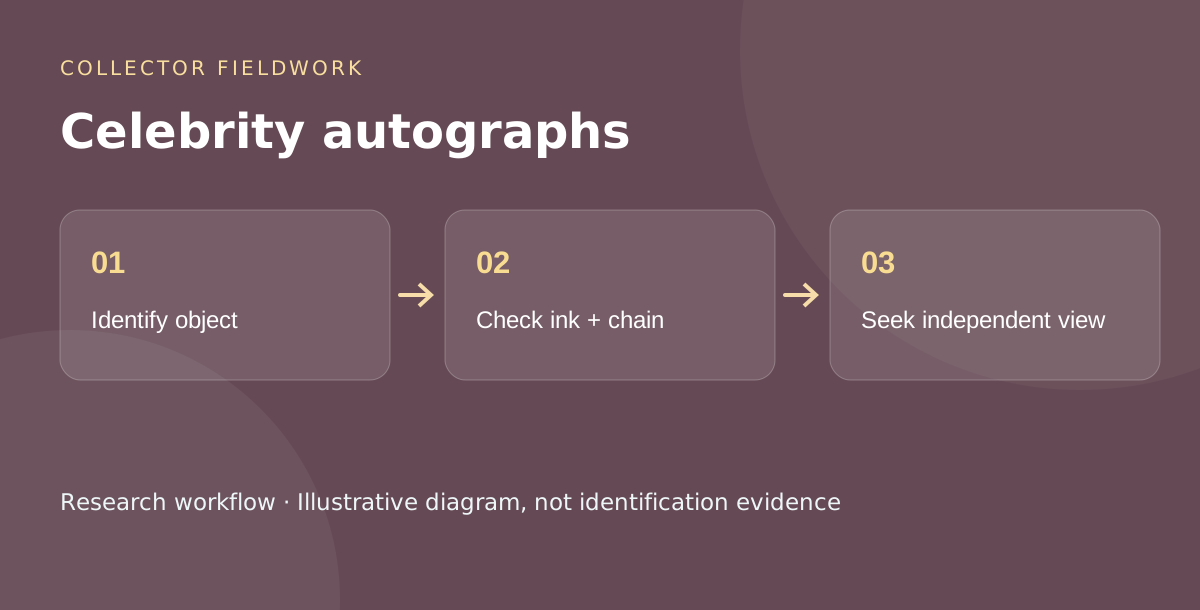
Ask whether the 8×10 is an original-era print, later photographic print, promotional image, modern reproduction, or home-printed copy. The answer affects collectibility even when the signature is genuine. Request images of the front and back, paper surface, any copyright or lab markings, and visible wear. Ask whether the listing photo shows the actual item for sale.
Do not assume a photo is period-original because it depicts a young performer. Photos are reprinted for decades, and a signature could have been added long after the image was taken.
Understand the autograph claim
“Hand signed” and “personally signed” require evidence; a seller-created certificate is not equivalent to independent examination. A preprint is part of the image and has not been individually signed. An autopen may physically apply a pen mark using a machine. Printed and mechanical signatures can look convincing in photographs.
Request angled, high-resolution closeups showing ink on the paper surface, line intersections, and areas where the pen changes direction. Those clues can raise or reduce concerns, but photographs alone are not definitive. Do not claim you can authenticate a signature using pen pressure inferred from a flat picture.
Provenance is a chain, not a story
A photograph of the signing event, ticket, dated receipt, correspondence, or documented acquisition may add context. Examine whether the evidence clearly identifies the exact item. A generic convention photo proves that an event occurred; it does not prove that the object offered was signed there.
Third-party authentication can be useful, but read exactly what was authenticated and by whom. A serial number lookup is only part of the check. PSA specifically warns that public certification numbers can be copied; compare the actual sticker, letter or holder with the official record and consider independent review for higher-value pieces.
Compare like with like
A signed 8×10, signed album jacket, signed bookplate, and handwritten letter are not automatically interchangeable in the market. Similarly, an inscription to a named fan, the condition of the photograph, and the availability of better examples can affect demand. Compare completed sales where possible, and look for repeated evidence rather than a single unusually high asking price.
Add framing and shipping risks. Glossy prints can crease or scuff, and fragile signatures can deteriorate with poor light exposure. For display, prioritize preservation-oriented materials and avoid direct sunlight. The Library of Congress cautions that all light can damage works on paper, even where UV filtering is used.
Questions to send the seller
- Is the signature handwritten on this exact photo, or printed as part of the image?
- When and where was it acquired, and what records support that claim?
- Is the paper an original-era print or a later reproduction?
- Can you send unedited front, back and angled signature images?
- Who authenticated it, and what does that authentication actually cover?
- What are the return terms if independent review raises material concerns?
If the seller cannot answer every question, that does not establish fraud. It does mean the unknowns belong in your price and risk assessment. A careful buyer is purchasing evidence, not just ink.
Build a repeatable evidence set
For the front view, use soft even light and include the full object rather than cropping to the most flattering detail. For the reverse, keep the same orientation and enough image resolution to read printing, labels or mechanisms. Add a third group of closeups for the physical details raised by this topic. Keep original, unedited photographs in addition to annotated copies. Every image should carry an item ID, so a comparison or dispute never depends on guesswork.
Useful filenames follow the pattern ITEM-014-front, ITEM-014-back, ITEM-014-detail-A. If a seller cannot provide the key view, record that as unresolved—not as proof of deception.
The photographs or records that would settle it
Ask for whole item, oblique ink closeup, reverse/edition and any actual certificate. A photograph should be useful for diagnosis rather than just flattering. Save uncropped originals and label the views consistently so a specialist can request an additional angle without losing track of the object.
For An Autographed 8×10 Photo: The Evidence to Request Before Buying, a useful listing names the scope of what the seller actually checked: photo print era, ink, inscriptions and documented source. An absent identification detail is different from ordinary cosmetic wear; it can change what object a buyer thinks they are purchasing. Save the seller’s answer beside your own observations.
A comparison worksheet for this exact question
| Question to resolve | Evidence to record | Decision if missing |
|---|---|---|
| Object type, edition, subject and date | Photograph, catalog reference, seller response or exact observation | Mark as not fully identified; defer valuation. |
| Location and documented signing circumstances | Photograph, catalog reference, seller response or exact observation | Use original photo, label or third-party catalog; ask for a closeup. |
| Whether ink is original, printed or mechanically applied | Photograph, catalog reference, seller response or exact observation | Price or sell conservatively; document the uncertainty. |
| Who issued any authentication document and what it covers | Photograph, catalog reference, seller response or exact observation | Seek specialist review if value materially depends on it. |
An illustrative decision—not a market valuation
Suppose two examples are advertised as the same kind of collectible. One provides object type, edition, subject and date and location and documented signing circumstances; the second uses only the broad category name and a single dramatic photo. The better-documented example is easier to research, return, insure and resell. That does not automatically mean it is worth more. It means fewer important facts are being left to imagination.
For the final purchase calculation, combine the actual bid or price, buyer premium if applicable, taxes, delivery, insurance and any known service costs. Never compare a dealer asking price directly with an auction hammer price. Use the interactive total-cost calculator to model your own numbers; none are represented here as live market quotes.
If you have more than one item, use the inventory CSV maker to preserve the evidence while each item is still in its original housing. The tool runs locally in your browser without uploading an inventory.
The non-obvious part
A famous autograph book became a travel archive. Smithsonian Magazine reported that Joseph Mikulec collected tens of thousands of signatures on a remarkable walking journey. The unusual part is not just who signed: dates, places and the collector’s route turned a book into a historical record. Primary source.
Mistakes to avoid and a safe stopping point
The main trap in this category is treating a seller-made certificate as independent authentication or assuming appearance alone proves signing method. Before a purchase or alteration, confirm: (1) the identity, (2) physical condition, (3) documentation, and (4) the financial or legal consequence of being wrong. If any one of those is material but cannot be checked, ask for evidence or decline the transaction.
Editorial accuracy boundary: Autopen and preprint risk. This is a verification requirement, not an assertion that the item under discussion has passed inspection. No unseen object is authenticated, appraised or certified by this guide.
Seller question you can copy into a message
I am researching an autographed 8×10 photo: the evidence to request before buying. Could you show object type, edition, subject and date and explain photo print era, ink, inscriptions and documented source? Please distinguish what you checked personally from what came from a previous owner or grading label. I would also appreciate your return terms if the identification is incorrect.
The answer should create something you can verify, not merely a reassuring adjective. If a seller gives a precise limitation (for example, “I have not tested signed object and signature evidence”), record that limitation exactly. It may be honest and useful without proving the condition you need.
Practical questions readers ask
What matters most for an autographed 8×10 photo: the evidence to request before buying?
The first test is object type, edition, subject and date, followed by location and documented signing circumstances. Those details let you narrow the object down before anyone starts guessing a premium.
What if the listing has too few pictures?
Request an uncropped view that resolves the missing identifying mark or condition question. You can save the listing for later, but do not use its price as a comparable until you know the versions actually match.
Should I repair, clean, open or alter it before asking an expert?
Usually document first. An alteration can remove provenance or condition evidence; fragile items and high-value pieces merit qualified advice. The right treatment depends on material and condition rather than an all-purpose cleaning hack.
Marketplace research after identification
Disclosure: We may earn a commission if you purchase through this eBay link. This does not affect the identification steps or any conclusion above.
Browse relevant eBay listings to inspect — search for “authenticated signed celebrity photo.” This is a live search, not a verified offer or completed-sale price. Check the actual listing, seller, legality where relevant, and return terms. For valuations, separately review genuinely comparable sold transactions.
References, research limits and related reading
- Library of Congress photograph care — official or specialist guidance, not a certificate for the item in this article.
Companion guides in this package (publish these routes together):
- Autopen, Preprint or Hand-Signed? What Photos Can and Cannot Tell You
- Signed Vinyl Records: Jacket, Insert and Disc Value Differences
- A Certificate of Authenticity From the Seller: What It Really Means
Collection and buyer education, not individualized appraisal, authentication, legal or investment advice. We have not physically inspected the collectibles described. Affiliate transactions should be independently verified before publication.